
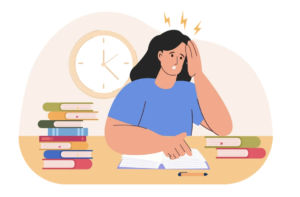
As a student, I’ve learned that while college can be exciting and full of opportunities, it also comes with a level of stress that many people don’t fully understand until they experience it themselves. College consists of exams, loads of homework, deadlines and more . It’s more than passing classes as some of us have to maintain certains GPA’s to recieve college aid. Research shows that academic stress is one of the main factors affecting students’ mental health, with a strong link between stress levels and overall well-being (Barbayannis et al., 2022). From personal experience, it can feel like there’s always something due, and even a little bit of falling behind can feel overwhelming.
As college is mentally draining, it is expensive too. Tuition, textbooks, rent, and daily expenses add up quickly. Some students have to take out multiple loans just so that they can pay for their classes or dorm on campus. Many students work while attending school full-time, which adds another layer of pressure. This constant balancing act can make it difficult to focus fully on academics or personal well-being. It’s not just about studying, it’s about surviving financially while trying to succeed. I have multiple friends that have taken out thousands of dollars to pay for classes and live with 4 other roomates in an apartment while working. It just seems like not only is their pressure for passing classes, but having to figure out how to pay for $300 textbooks and food can be stressful on top of that too. College stress goes beyond feeling “busy.” For many students, it affects mental health in serious ways. Studies show that about 78% of college students report moderate to high stress levels (Bryant & Welding, 2023). As well as, around 20% experience serious psychological distress (Bryant & Welding, 2023).
From a student’s perspective, this feels like constantly being overwhelmed, trying to keep up with school, relationships, and responsibilities all at once. College students are expected to be students while working to support themselves, and to have time for friends and family. Even though college stress is real, it’s important to recognize that it also comes with growth. Students learn independence, time management, and resilience. However, that doesn’t mean the stress should be ignored. Many students are still struggling silently, and more awareness and support are needed. It is difficult to try to balance school, work, and life and not feel stressed or be exhausted. For me, I work full-time and go to school full-time, and I’ve been doing that for a long time now to support myself, and it’s not easy. There are days when it feels like there simply aren’t enough hours in the day.
By understanding that students can become overwhelmed with stress from college is imprtant not just for students, but for educators and society as a whole. It is difficult for students to focus on school as well as other parts of their lives at a young age, as adults trying to navigate their way through the world. With better support systems and awareness, college can become not only a place for learning, but also a healthier environment for students to grow and succeed.
References
Barbayannis, G., Bandari, M., Zheng, X., Baquerizo, H., Pecor, K. W., & Ming, X. (2022, May 23). Academic stress and mental well-being in college students: Correlations, affected groups, and covid-19. Frontiers in psychology. https://pmc.ncbi.nlm.nih.gov/articles/PMC9169886/?utm_source=chatgpt.com
Bryant, J., & Welding, L. (2023, February 15). College Student Mental Health Statistics: Bestcolleges. Bestcolleges.com. https://www.bestcolleges.com/research/college-student-mental-health-statistics/?utm_source=chatgpt.com