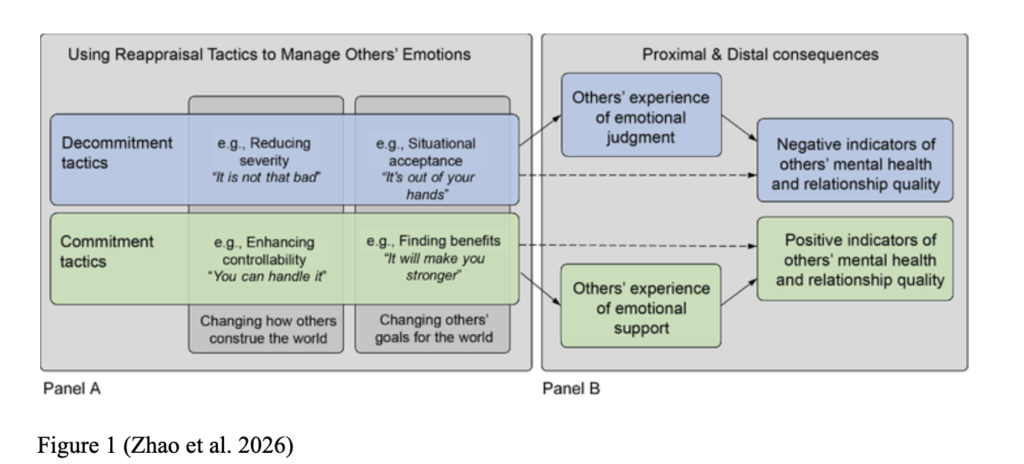
When talking to a loved one who is dismayed, sometimes one can say something that they feel is correct, but accidentally hurt the person. This is very common and happens to most people, but often there are different tactics people will try throughout their lives. Zhao et al. try to answer the question of what way consoling someone is most helpful to them. This can be done through reappraisal which has the person looking at said emotions through a new perspective. The researchers found that there are 4 different types of tactics that are used in order to console people: reducing severity, situational acceptance, enhancing controllability, and finding benefits. Reducing severity and situational acceptance are considered decommitment tactics while enhancing controllability and finding benefits are considered commitment tactics. Using commitment tactics rather than decommitment tactics is beneficial and shows as a positive indicator of relationship quality.
Some of the difficulty of managing other people’s emotions is knowing how to approach different situations, there are 2 ways that are considered positive. Even if the intentions can be good, it can also tell much about the relationship with the person. Commitment tactics are considered strategies that are productive, and can be a sign of a positive relationship with the person. Commitment tactics try to give new control over the situation, “commitment tactics involve proposing new perspectives based on an understanding of others’ existing perspectives” (Zhao et al. 2026). They take into respect that the person is feeling negative about a situation, and aim to uplift them from that situation. That person has their own opinions and feelings on a subject, being able to possibly reframe their thoughts can be beneficial. Enhancing controllability is one of the commitment tactics used, “[where you construe] different elements of the situation that may be more controllable than the elements first considered” (Zhao et al. 2026).
Within Figure 1, they use the example of “you can handle it”(Zhao et al. 2026). This is trying to uplift the person into reframing their thoughts to make them feel as if they have more agency in the situation. This can be done by having them consider previous goals that they might have done to inspire them. The other commitment tactic is finding benefits which is, “committing to an alternative goal for the situation than what was originally considered” (Zhao et al. 2026). Within Figure 1, they use the example of “it will make you stronger” (Zhao et al. 2026). Using the finding benefits tactic encourages them to consider it a learning experience in a positive way and improves their perspective of the situation. Commitment tactics are considered to be positive and exemplify a positive relationship with that person. They show a higher respect for the emotions of the person going through the hardship while allowing them to push forward through it.
On the contrary there are decommitment tactics which often have good intentions but are considered negative to employ. Decommitment tactics are considered unproductive since they challenge their perspective in a negative way. Decommitment tactics downplay situations, defined as, “suggesting a situation is not that serious after all and/or that their goal to change the situation is not worth pursuing” (Zhao et al. 2026). Compared to commitment tactics, decommitment tactics do not acknowledge the feelings of the person who is struggling. They often take into account the speaker’s perspective on the situation rather than the person who is struggling’s perspective.
One of the 2 ways that decommitment tactics are employed are with reducing severity. Reducing severity will downplay a situation, it is “a tactic that involves decommitting from an initial construal about the situation being severe” (Zhao et al. 2026). Within Figure 1, they use the example of “it’s not that bad” (Zhao et al. 2026). This is considered a negative method because it is downplaying their emotions. Reducing severity wants to change how they view the world, but in a way that does not take their current emotions about the situation into account. The other decommitment tactic is situational acceptance. Situational acceptance is described as, “a tactic that involves decommitting from an initial goal that the situation be different than its current—dissatisfactory—state” (Zhao et al. 2026). Within Figure 1, they use the example of “it’s out of your hands” (Zhao et al. 2026). This method pushes down the abilities of the person who is experiencing turmoil. People have control over situations, and making someone feel hopeless. This changes their goals to be lower than what they were wanting and affects their mental health negatively. Decommitment tactics are often used to downplay the feelings of the person, and can often be a signpost of how the person can feel in the relationship with that person.
Within both decommitment and commitment tactics, the speaker does listen to the person they are trying to help but the method of employment can show care or lack thereof. Commitment tactics take into account the listener’s feelings, and it was shown through the study that, “controllability and finding benefits—both commitment tactics—predicted recipients’ experience of greater support.” Furthermore, they found the contrary as well that, “both decommitment tactics—predicted recipients’ experience of greater judgment , which itself predicted worse recipient mental health and relationship quality” (Zhao et al. 2026). Since the commitment tactics take into account the feelings of the person sharing the information, it is linked to better outcomes. There is an implicit judgement that comes from decommitment tactics. That judgement comes in the form of it downplaying their emotions. It implies that their emotions are not as important as they feel that they are in this situation. Those who use commitment tactics are shown to have better mental health and relationships because they give more respect to the emotions who are going through turmoil. Overall, it was shown that considering the feelings of the person expressing their emotions were very important in developing the right tactic.
While commitment tactics are better for mental and emotional health, it can be expanded upon. A way suggested to possibly improve these reappraisal tactics is to state intentions clearly, “express that their intention is to help the recipient improve their emotions rather than judge their emotions, regardless of the type of tactics being used” (Zhao et al. 2026). There is more to be done in this study, and possibly finding what might be most effective overall would be a beneficial direction to take with this idea. This is a field of study that has often been employed through therapy and discussed within therapy techniques, but little directly studied. Each situation is unique, but using the correct tactic can create better outcomes for everyone.
Take Away Points:
-
Using a tactic that takes into account the person’s feelings about the situation rather than downplaying them creates better outcomes.
-
Stating your intentions with the help may be a fruitful way to approach conversations.
-
Downplaying the emotions of someone who is having problems affects their mental and is a sign of an unhealthy relationship.
References:
Moors, A., Ellsworth, P. C., Scherer, K. R., & Frijda, N. H. (2013). Appraisal theories of emotion: State of the art and future development. Emotion Review , 5 (2), 119–124. 10.1177/1754073912468165
Uusberg, A., Taxer, J. L., Yih, J., Uusberg, H., & Gross, J. J. (2019). Reappraising reappraisal. Emotion Review , 11 (4), 267–282. 10.1177/1754073919862617
Zhao, Y., Sisson, N. M., Pringle, V., Smith, A. M., Long, E. U., Elsaadawy, N., Carlson, E., & Ford, B. Q. (2026). Managing loved ones’ emotions: The promise and pitfalls of reappraisal. Emotion. https://doi-org.lib-proxy.fullerton.edu/10.1037/emo0001648