“Mental decline is common, and it’s one of the most feared consequences of aging. But cognitive impairment is not inevitable” (Harvard Health).
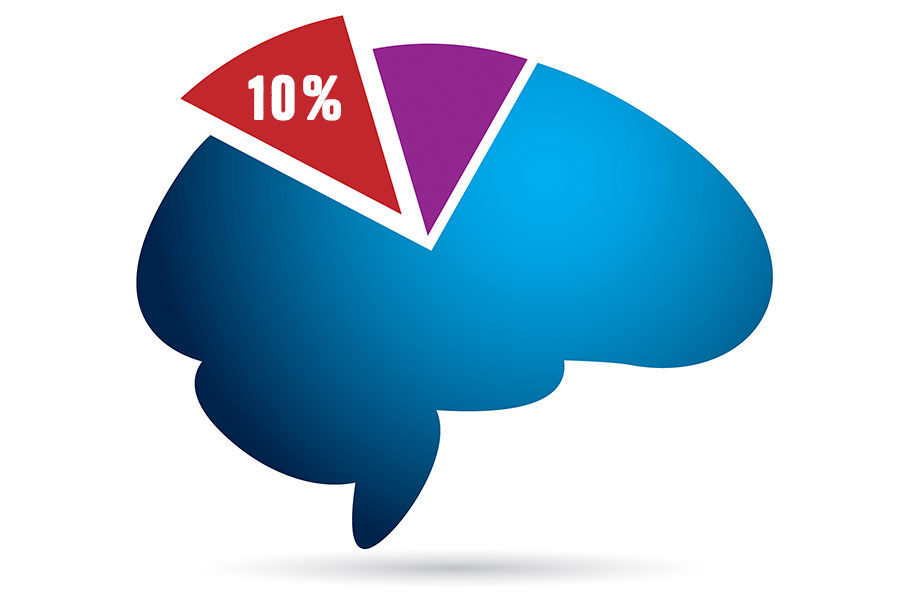
A common misconception is that people only use 10% of their brain. This is something that has been said in day-to-day life, and this is a misconception that is often repeated by early psychology students as well. One could not be faulted for believing it, especially after learning about great scientists such as Albert Einstein or George Katherine Johnson. Meanwhile, many could only dream to be as impactful in the field of science. Some people might take some solace in the fact that most of us are not able to unlock part of that last 90% of our brain to use. This could give more credence to the misconception.
Because this misconception is so widespread, it is important to examine its origins. One early source is a statement by William James, who suggested that most individuals do not reach their full intellectual potential (Lilienfeld, 2011). Over time, this idea was misinterpreted to mean that humans use only a small fraction of their brain.
The concept was further popularized by a 1929 World Almanac entry claiming that people use only about 10% of their brain power (Beyerstein, 2022). Although intended to be motivational, such statements were easily misunderstood and reinforced by self-help literature. As a result, the idea spread quickly and became a widely accepted—but incorrect—belief.
One possible source of this misconception is the comparison to vestigial structures in the human body. For example, the tailbone, appendix, and tonsils are often thought to have limited or nonessential functions. This can lead to the mistaken assumption that, like these structures, parts of the brain may also be unused. However, this comparison is inaccurate. Unlike vestigial organs, all regions of the brain have identifiable and important functions. Early neurologists may have contributed to this misunderstanding by suggesting that certain areas, such as the association cortex, lacked a clear purpose. As later research has shown, the association cortex plays a critical role in language, abstract thinking, and complex sensory-motor processing (Lilienfeld, 2011). These early misconceptions, combined with a tendency to mythologize highly accomplished individuals, may have reinforced the idea that most people are not using their full brain capacity.
In contrast, the brain is one of the most metabolically active organs in the body, making the idea of large unused portions unlikely. As neuroscientist Mark Harnett explains, “all of our brain is constantly in use and consumes a tremendous amount of energy.” Despite accounting for only about 2% of body weight, the brain uses approximately 20% of the body’s energy (Veerakone, 2024). This high energy demand reflects the brain’s continuous role in regulating both conscious and unconscious processes. If large portions of the brain served no function, it would be inefficient for the body to maintain such an energetically costly organ. Therefore, while comparisons to vestigial structures may seem intuitive, they do not accurately reflect how the brain functions and instead help perpetuate the “10%” myth.
Another unexplored aspect of this myth is the mythologizing people who may have more achievements than other people. It seems like some people can be gifted while some others could only dream of reaching the achievements of those who might be gifted in academia. When looking at many different sources, focusing on your health, and especially your brain health. Similar to the rest of your body, your brain is an organ. Similar to the rest of the organs in the body, making sure to take care of one of them helps all of them. According to Health Harvard, “Mental decline is common, and it’s one of the most feared consequences of aging. But cognitive impairment is not inevitable.” Mental decline does not need to be feared as long as the body has the drive to do better. Doing and treating the body in a way that promotes healthiness affects the brain and improves cognitive abilities. Some ways to help stop mental decline include diet, exercise, and minimal to eliminating consumption of drugs such as alcohol and tobacco. The decline or damage of one part of the body often affects other parts of the body in ways that do not seem self-explanatory. Consider when one is sick, that person may not be able to perform the same mental or physical abilities that they would if they were healthy. When one part of the body suffers, often the rest will also experience negative consequences. If one wants to stymie the effects of mental decline, tending to the body mitigates that damage.
All in all the brain is an organ like the rest of the ones in the body. Making sure to take care of it is incredibly important to the long-term health of the body and can help one achieve those heights desired. While we don’t use only 10% of our brain, neglecting the brain and the needs of your whole body will only hamper the success that is possible from you. William James was not incorrect in his original assessment, people can achieve more if they set their mind to it.
Take Home Points
- Humans use essentially all parts of their brain, which together consume ~20% of the body’s energy.
- The “10%” myth likely arose from misinterpretations of early psychological ideas and popular media.
- Cognitive ability is influenced by health and environment—not unused brain capacity.
Resources:

12 ways to keep your brain young. Harvard Health. (2022, May 13). https://www.health.harvard.edu/mind-and-mood/12-ways-to-keep-your-brain-young

Beyerstein, Barry L. (1999), "Whence Cometh the Myth that We Only Use 10% of our Brains?", in Della Sala, Sergio (ed.), Mind Myths: Exploring Popular Assumptions About the Mind and Brain, Wiley, ISBN 978-0471983033

Lilienfeld, S. O. (2011). 50 great myths of popular psychology: Shattering widespread misconceptions about human behavior (Vol. 1). Wiley-Blackwell.

Miller, K. (2025, December 9). Scientists say this simple habit boosts brain health in as little as 12 weeks. Michigan State University Health Care. https://healthcare.msu.edu/news/2025-12-28-Scientists-Say-This-Simple-Habit-Boosts-Brain-Health-in-as-Little-as-12-Weeks.html

Veerakone, R. (2024, January 26). Do we only use 10 percent of our brain?. MIT McGovern Institute. https://mcgovern.mit.edu/2024/01/26/do-we-use-only-10-percent-of-our-brain/