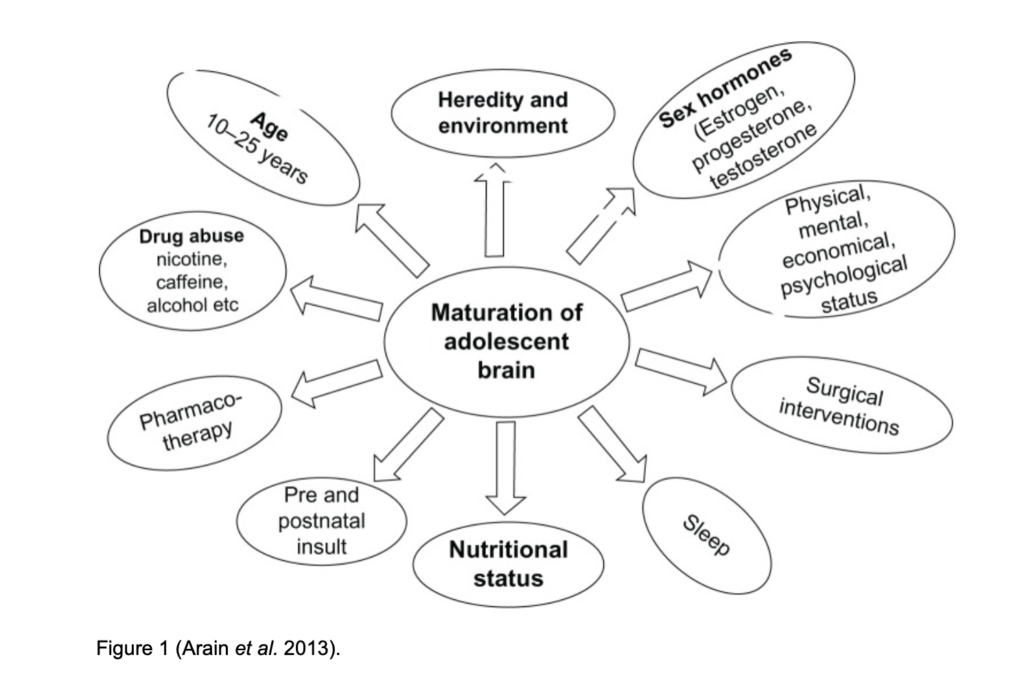
Brain maturation is influenced by heredity and environment, prenatal and postnatal insult, nutritional status, sleep patterns, pharmacotherapy, and surgical interventions during early childhood” (Arain et al. 2013).
Hello everyone! My name is Winter, and I will be exploring misconceptions in psychology through a series of blog posts. A focal point I have learned while researching psychology is that often there will be misinformation circulated as fact. Misconceptions are important to quell because people outside of psychology might spread these rumors as they believe them to be true.
Today the myth I want to address is that the brain stops growing or changing past the age of 25. I had thought this was true as well after talking to some of my friends, but quickly learned otherwise when I looked into it more. Rather than an individual part that makes the aging of the brain, there are a variety of factors instead.
When looking at this myth, a person needs to start from the beginning. In this case, it is in the development of the brain. One scientist wrote: “Brain maturation occurs during adolescence due to a surge in the synthesis of… hormones implicated in puberty including estrogen, progesterone, and testosterone” (Arain et al. 2013). This means that there is a rapid development of the brain early on. However, there is some truth behind this myth that the brain ceases changing after age 25. The same researcher goes on to say: “The development and maturation of the prefrontal cortex occurs primarily during adolescence and is fully accomplished at the age of 25 years” (Arain et al. 2013). How the brain is developed has a wide variety of factors, “brain maturation is influenced by heredity and environment, prenatal and postnatal insult, nutritional status, sleep patterns, pharmacotherapy, and surgical interventions during early childhood” (Arain et al. 2013).
The environment can play a critical role in someone’s development especially. For example, schooling can have a substantial impact on someone’s maturation. Students develop new ways of thinking that might not occur otherwise without school. The ability for the brain to adapt to new situations quickly is known as neuroplasticity. The brain continues to develop and change even though it has completed maturing due to neuroplasticity. When discussing how long the brain continues to have plasticity Zull J. E. wrote, “The extensive plasticity of the brain continues throughout life” (Zull, J. E. 2004). New novel situations are ways for the brain to keep changing and learning throughout a person’s entire life.
Neuroplasticity is what allows someone to learn a new skill later in their life. Keeping it honed as you age is very important. It is important for people to continue to practice critical thinking throughout one’s life to ensure brain growth and development. It is crucial to continue to do different things and expand your knowledge. Continuing to put yourself into complex new situations or experiences keeps your brain learning. This retains and emboldens your plasticity and makes your brain continue to grow and develop into adulthood. You make new pathways between the neurons in your brain which in turn allow you to keep having your brain continue to grow and learn into adult life. The brain never stops growing or changing, but it does stop maturing.
Something of note when it comes to research on this topic is the stressors of early childhood. Nutrition plays a large role in the development of the brain. Children and young adults who do not have sufficient food intake will experience a decline in their overall quality of life. Every source that I read about the subject also importantly highlighted that things such as nutrition, schooling, and having a positive environment will create those positive outcomes that are desired. See figure 1 for a diagram for more ideas of a lot of the parts that comprise brain development. Making sure children grow up in a low stress environment with all of these positive elements will have the child or young adult grow into someone who continues to have parts of their mind growing at all times.
All in all, despite what the misconception might lead you to believe, the brain continues to develop throughout the person’s life. While the brain stops maturing at 25, it still continues to change. That change comes from the plasticity of the brain. Doing new hobbies, activities, and critical thinking are all excellent ways to preserve and embolden the plasticity that the brain already has. Furthermore, improving the conditions around the person affect the maturation of the brain, which include: food intake, schooling, environment.
Take Home Points:
- Continuing to work and train your brain throughout your life is important for continued growth
- There are a variety of factors that affect development and brain function including nutrition, sleep habits, and environment
- Plasticity can fray and be emboldened throughout your life so continuing to foster that leads to better brain development.
- New hobbies, activities, and critical thinking keep the brain sharp and are vital to embolden and retain
Resources:
Arain, M., Haque, M., Johal, L., Mathur, P., Nel, W., Rais, A., Sandhu, R., & Sharma, S. (2013). Maturation of the adolescent brain. Neuropsychiatric disease and treatment, 9, 449–461. https://doi.org/10.2147/NDT.S39776
Lilienfeld, S. O. (2011). 50 great myths of popular psychology: Shattering widespread misconceptions about human behavior (Vol. 1). Wiley-Blackwell.
Zull, J. E. (2004). The art of changing the brain. Educational leadership, 62(1), 68-72.